Coffee to Water Ratio Calculator
Get the same great cup every time by brewing to a ratio. Choose your method and strength, enter how much coffee you want to make — or how much ground coffee you have — and the calculator gives exact grams of coffee and water.
- Free to use
- No sign-up
- Runs in your browser
Calculate coffee and water
Coffee Brewing Guide & Log
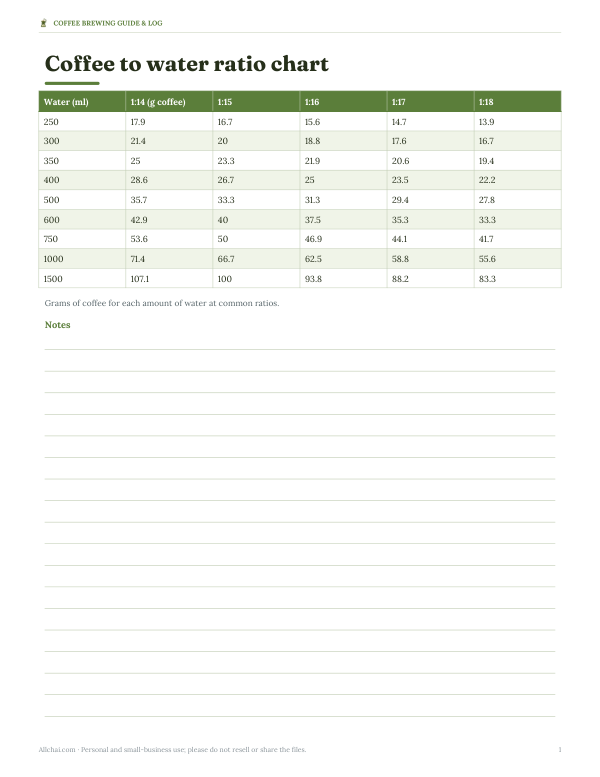
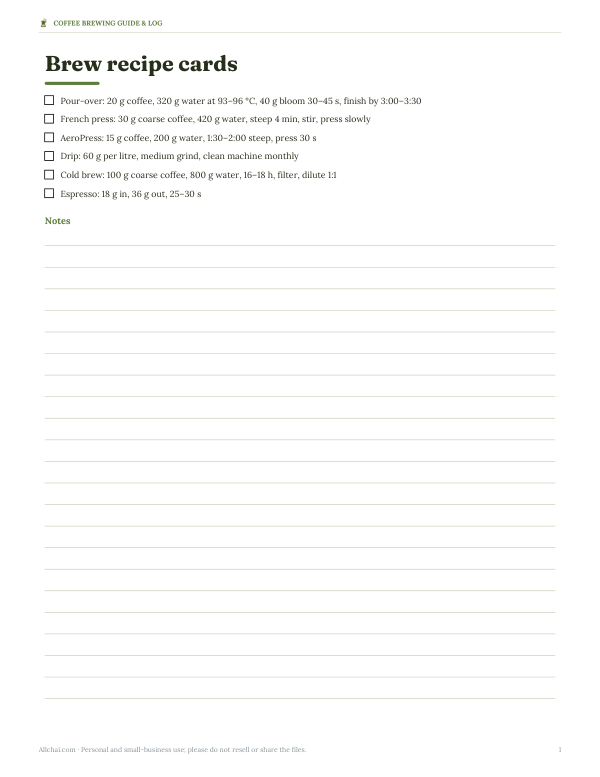
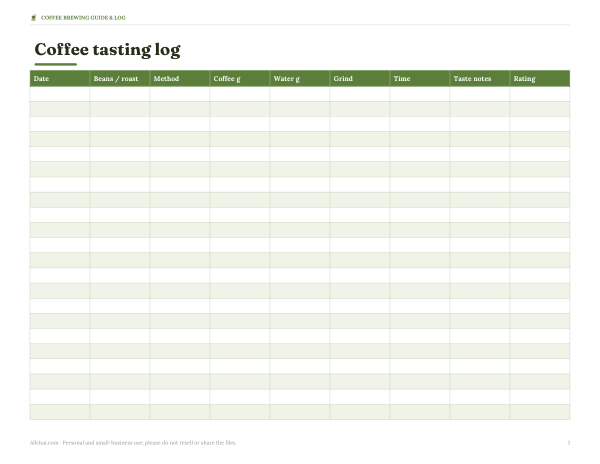
A printable brew-ratio chart for your kitchen, recipe cards for each method and a tasting log to dial in your coffee.
- Brew ratio chart (PDF, XLSX)
- Recipe cards by method (PDF, DOCX)
- Tasting log (PDF, XLSX)
Formats: PDF, XLSX, DOCX. Instant download after payment (link valid 72 hours, up to 5 downloads). AI-assisted: the templates were drafted with AI help and reviewed and laid out before publishing.
$3.00 USD, one-time 3 files · about $1.00 each
- Instant download
- 7-day refund
- Secure checkout by Stripe
7-day money-back guarantee. Full refund within 7 days of purchase, even after you download.
Full refund within 7 days — see the refund policy and license.
Free printables
Single sheets you can print right now, no sign-up. The full pack adds every sheet in one download plus the editable files.
Why brew coffee by ratio
The coffee-to-water ratio is the single biggest factor in how strong your coffee tastes. Measuring with a kitchen scale instead of scoops removes guesswork: different beans and roasts have different densities, so a scoop of dark roast weighs less than a scoop of light roast. Once you find a ratio you like, you can scale it to any amount — one mug or a full carafe — and get the same strength. The calculator does the arithmetic and adjusts for stronger or milder preferences.
Standard ratios by brew method
| Method | Typical ratio | Example |
|---|---|---|
| Pour-over (V60, Chemex, Kalita) | 1:15 – 1:17 | 20 g coffee to 320 g water |
| Automatic drip | 1:16 – 1:18 | 60 g coffee to 1,000 ml water |
| French press | 1:12 – 1:15 | 30 g coffee to 420 g water |
| AeroPress | 1:11 – 1:16 (varies by recipe) | 15 g coffee to 200 g water |
| Moka pot | about 1:7 – 1:10 | fill the basket; ~18 g to 150 g water |
| Cold brew concentrate | 1:4 – 1:8 | dilute before drinking |
| Cold brew ready to drink | 1:10 – 1:15 | no dilution needed |
| Espresso | 1:1.5 – 1:3 (beverage weight) | 18 g coffee → 36 g espresso |
The Specialty Coffee Association's long-standing “Golden Cup” recommendation of about 55 grams of coffee per litre of water works out close to 1:18. Many home brewers prefer slightly stronger, around 1:15 to 1:16.
Worked example
For two 240 ml mugs of pour-over at 1:16, you need 480 ml of water and 480 ÷ 16 = 30 g of coffee — about five and a half level tablespoons of ground coffee. If you like it a little stronger, the “stronger” setting raises the coffee to 33 g for the same water. If instead you have only 20 g of beans left, switch to “ground coffee I have” to see that it makes 320 ml at the same ratio.
Grams, millilitres and tablespoons
For brewing, one millilitre of water weighs one gram, so you can weigh water directly on the scale while pouring. Ground coffee is less predictable by volume: a level tablespoon holds roughly 5 to 6 grams depending on grind and roast. The calculator converts to tablespoons as a rough guide, but a scale accurate to 0.1 gram is one of the best inexpensive upgrades for home coffee.
Adjusting taste beyond ratio
- Too weak or watery: use more coffee (a lower ratio number) or grind finer.
- Too strong or heavy: use less coffee or add hot water after brewing.
- Sour or thin: often under-extracted — grind finer, brew longer or use hotter water (around 195–205 °F / 90–96 °C).
- Bitter or harsh: often over-extracted — grind coarser, shorten the brew time or lower the water temperature slightly.
- Change one thing at a time so you know what made the difference.
Cold brew ratios
Cold brew steeps coarsely ground coffee in cold or room-temperature water for 12 to 24 hours. A concentrate at 1:4 to 1:8 is strong and is usually diluted with water or milk before drinking — often one part concentrate to one or two parts water. A ready-to-drink batch at around 1:12 needs no dilution. Filter it well and keep it refrigerated, covered, for up to about a week or two; flavour fades over time.
Espresso ratios
Espresso uses a much lower ratio because it is a concentrated drink, and it is measured by the weight of the liquid espresso rather than the water used. A “normale” shot at around 1:2 — for example 18 grams of coffee yielding 36 grams of espresso in 25 to 30 seconds — is a common starting point. Ristretto shots use about 1:1 to 1:1.5; lungo shots 1:3 or more.
Grind size by method
Ratio and grind size work together: the finer the grind, the faster the water extracts flavour. French press and cold brew use a coarse grind similar to sea salt; drip machines and flat-bottom pour-over use medium; cone pour-overs such as the V60 use medium-fine; AeroPress ranges from fine to medium depending on the recipe; moka pots use fine; and espresso needs a very fine, consistent grind from a capable burr grinder. If you change method, change both the ratio and the grind, then fine-tune by taste.
Frequently asked questions
What is the best coffee to water ratio?
A good starting point is 1:16 for pour-over and drip; adjust between about 1:14 and 1:18 to taste.
How many grams of coffee per cup?
At 1:16, about 15 g of coffee per 240 ml (8 fl oz) cup.
How much coffee for a 12-cup coffee maker?
Coffee-maker “cups” are usually 5–6 fl oz. For about 1.8 litres at 1:17, use roughly 105 g of coffee.
Is the ratio by weight or volume?
By weight. Water in millilitres equals grams, so you can use either for water.
What ratio for French press?
Around 1:12 to 1:15; 1:14 is a popular choice.
How many tablespoons is 30 grams of coffee?
About 5–6 level tablespoons, depending on grind and roast.
Does bean freshness change the ratio?
Very fresh coffee releases more gas and can taste sharper; you may prefer a slightly longer bloom rather than a different ratio. Stale coffee tastes flat, and adding more grounds does not fully fix it.
Should I weigh beans before or after grinding?
Either — the weight is the same. Weighing whole beans first lets you grind exactly what you need.